
Projects
PROJECT SNAPSHOT
Location: Bay Ridge, Brooklyn, NY 11209
Project type: Kitchen cabinet wrapping / architectural film refinishing
Scope: Upper cabinets, base cabinets, tall pantry unit, kitchen island
Material: Bodaq Interior Film by Hyundai L&C
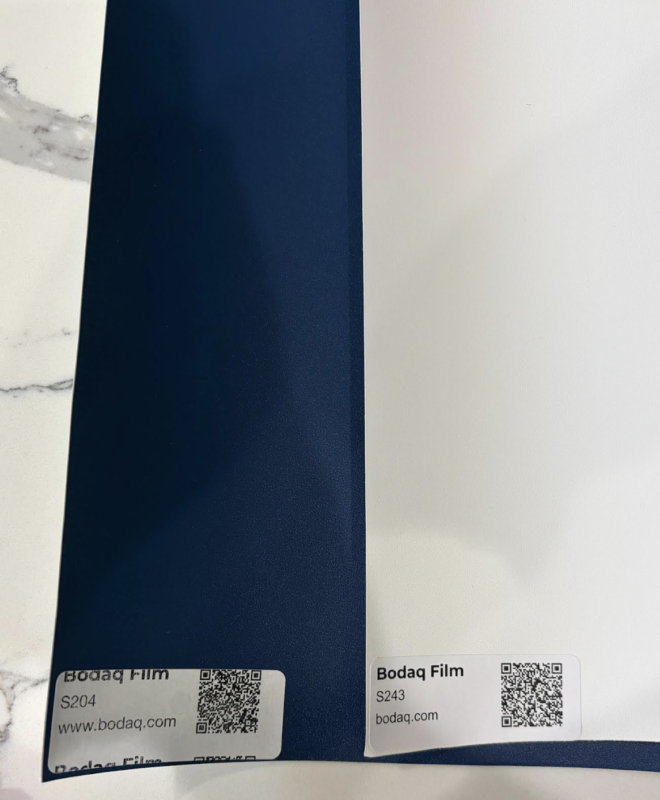
Finishes: S243 perimeter, S204 island
Duration: 3 calendar days
Labor: 25 hours, single installer
Demolition: None
Cabinet boxes replaced: None
Kitchen out of service: 0 days
Material warranty: 10-year manufacturer warranty (Hyundai L&C)
Workmanship warranty: 3 years from Vanta Surfaces
THE BRIEF
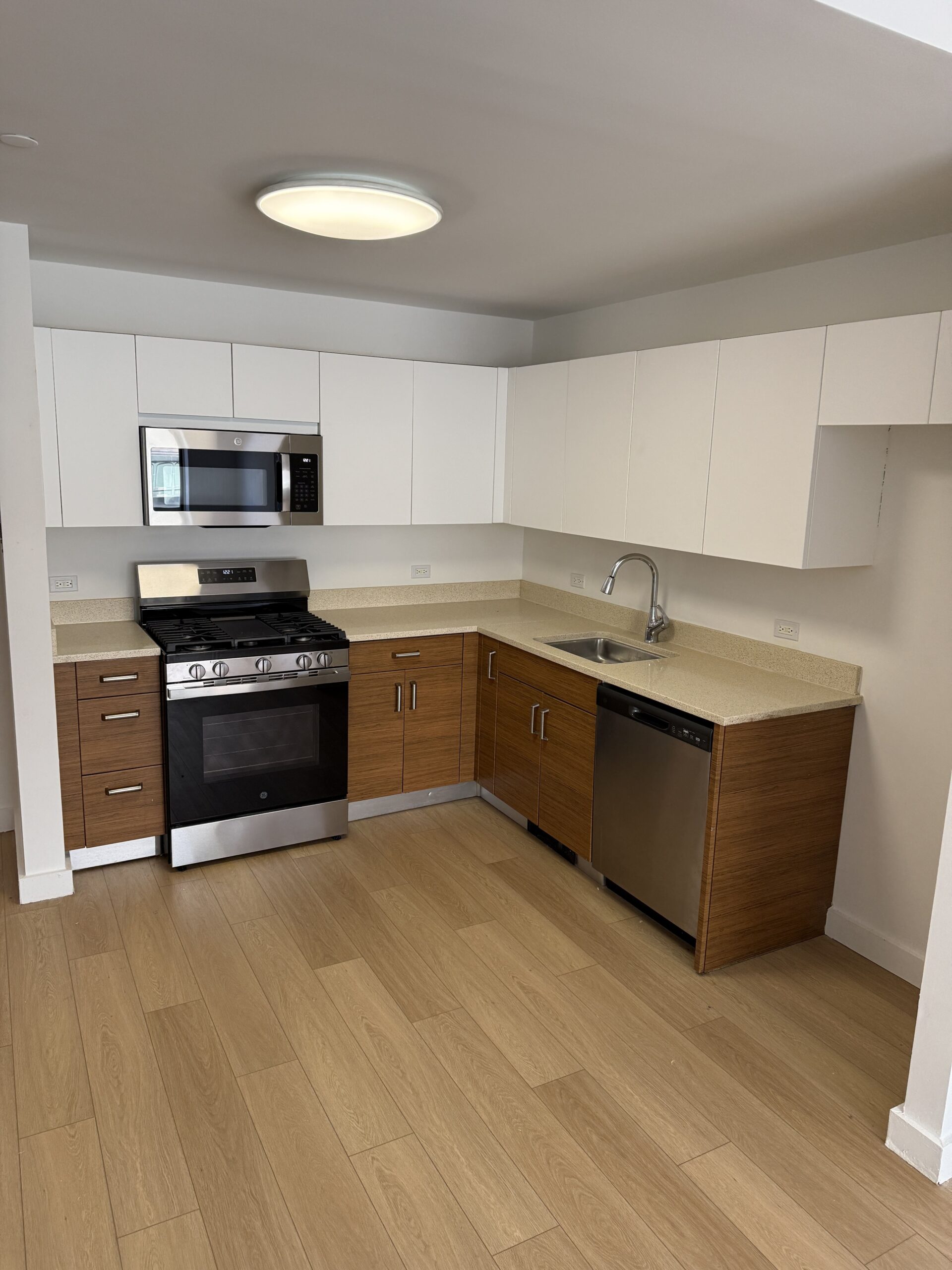
A homeowner in Bay Ridge came to us with a kitchen that was structurally sound and functionally fine — solid boxes, good hinges, soft-close drawers, a quartz countertop and a stacked-tile backsplash that had both been installed recently and were staying. The problem was purely visual. The cabinet fronts had aged into a flat, dated finish, and the room read as one undifferentiated block of cabinetry with no focal point.
The obvious quote she had already received was for a full cabinet replacement: rip out the fronts, order new doors, wait six to ten weeks on millwork, and live without a working kitchen through the middle of it. For a family that cooks daily, that trade-off did not make sense for what was, at bottom, a color problem.
We proposed cabinet wrapping instead.
WHY CABINET WRAPPING WAS THE RIGHT CALL HERE
Cabinet wrapping — also called cabinet refinishing with architectural film, or cabinet resurfacing — applies a self-adhesive, dimensionally stable interior film directly to the existing door faces, drawer fronts, frames and panels. The boxes stay. The hinges stay. The countertop and backsplash never get touched.
Three factors made this kitchen an especially good candidate:
The doors were flat-panel slab fronts. Handleless, European-style slab doors are the easiest geometry in this trade. There are no raised profiles, no recessed centers, no applied moulding to negotiate. Film lays down clean, edges wrap cleanly around the perimeter, and the finished result is visually indistinguishable from a factory-sprayed door.
The substrate was intact. No water swelling at the sink base, no delaminating melamine at the toe kick, no chipped corners. When a substrate is already sound, prep time collapses, and prep is where most of the labor in a refinishing job actually lives.
The countertop and backsplash were staying. This is the scenario cabinet wrapping is built for. A homeowner who likes 70% of the room and wants to change 30% of it is badly served by a gut renovation, which forces them to pay for and re-do the 70% they already liked.
THE DESIGN DECISION: GOING TWO-TONE
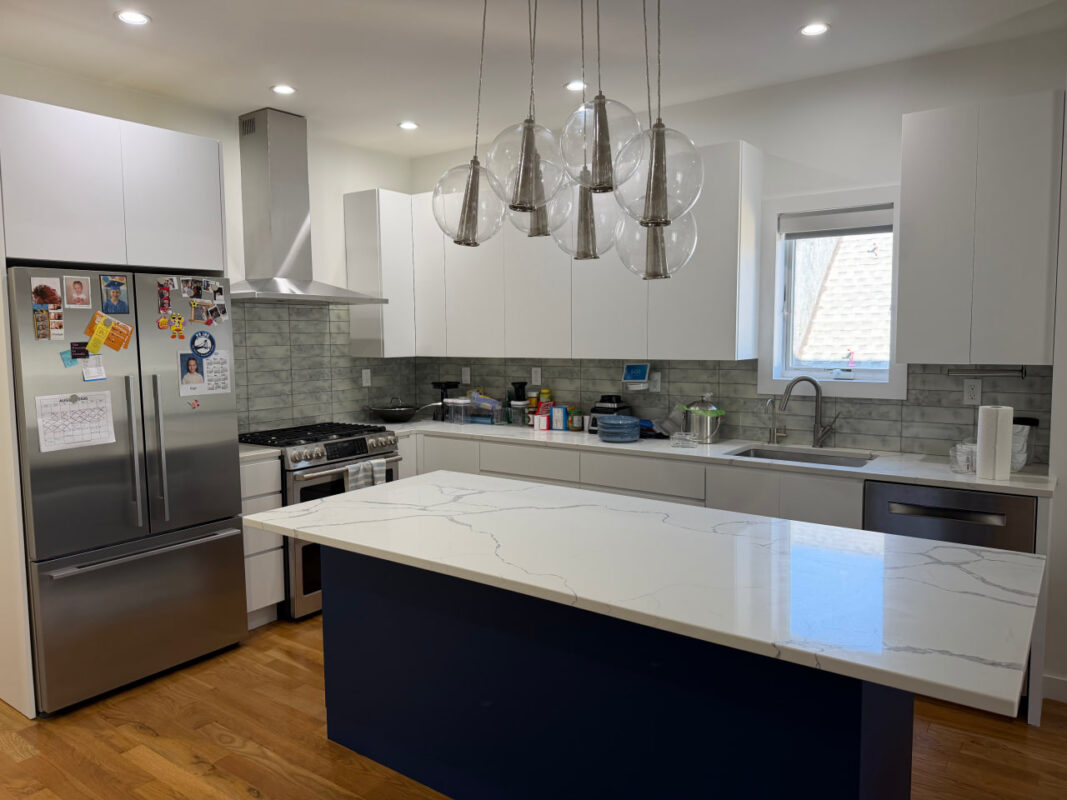
The original kitchen was monochrome. Every cabinet, upper and lower, perimeter and island, was the same shade of white. In a room this size, that reads as flat — the eye has nothing to land on.
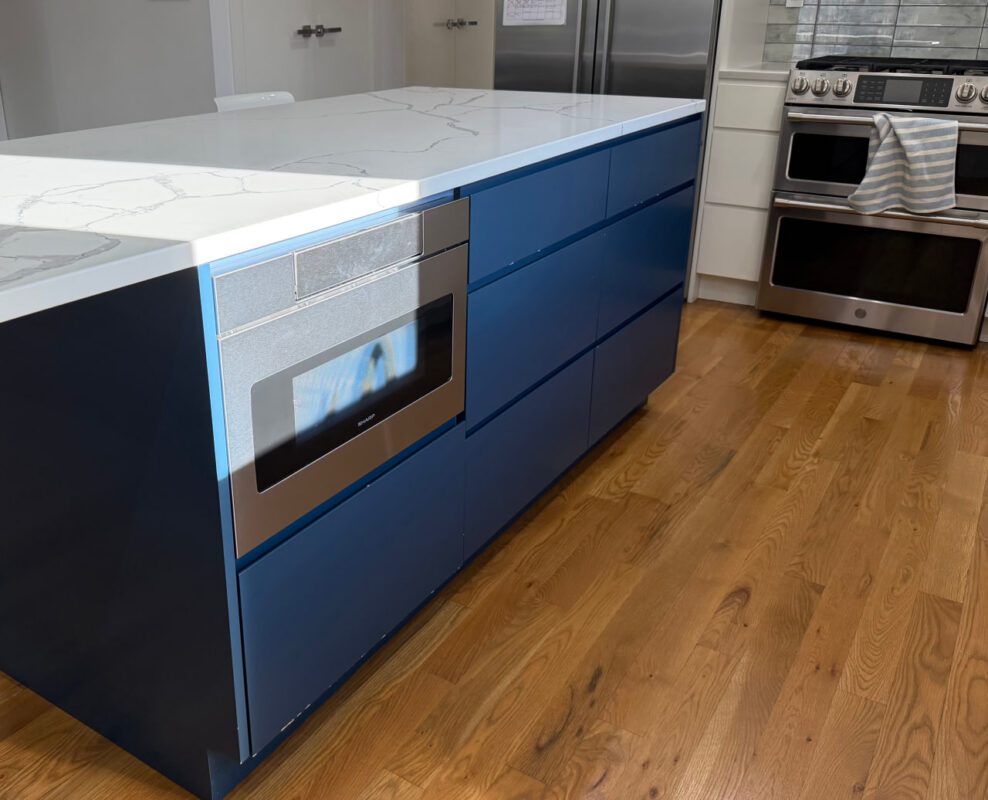
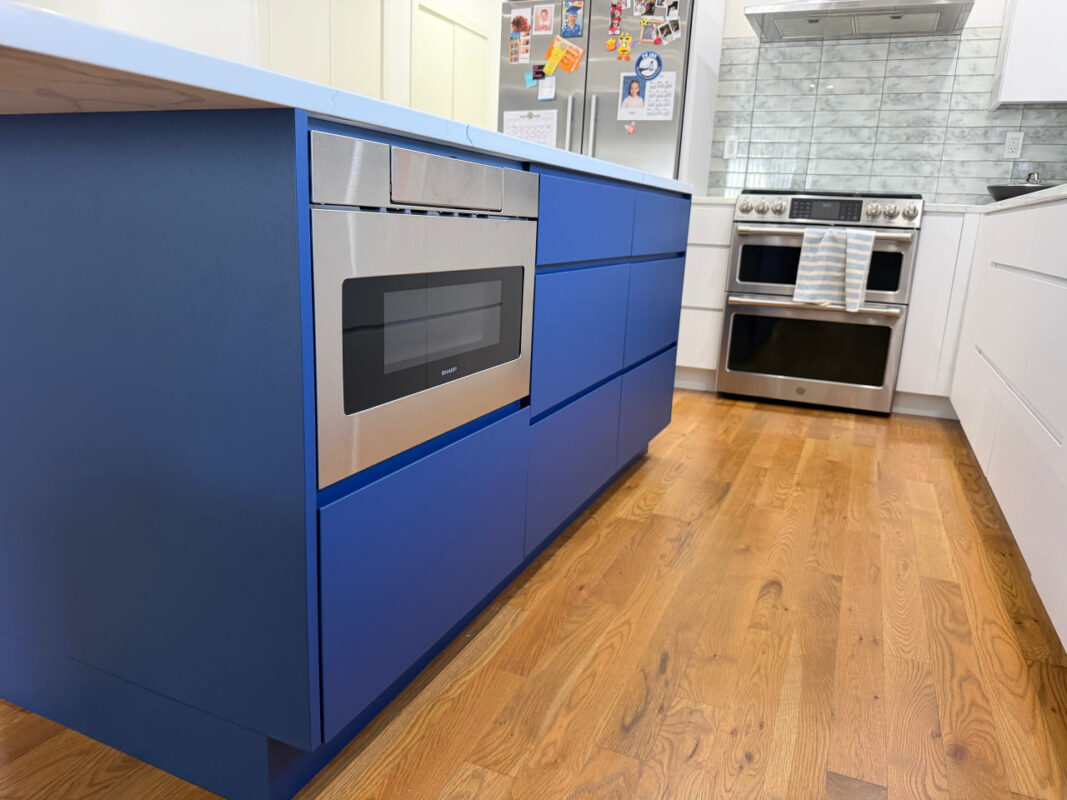
We took the perimeter cabinetry to a clean, low-sheen white in Bodaq which holds a slightly warmer, softer tone than the original finish and reads better against the cool grey of the stacked-tile backsplash. Then we anchored the room by wrapping the island in a deep navy, Bodaq .
The navy does three things at once. It gives the room a center of gravity. It picks up the grey veining running through the quartz waterfall countertop, so the island reads as one deliberate object rather than a slab sitting on a base. And it establishes contrast against the white oak floor without competing with it.
This kind of two-tone kitchen — white perimeter, dark island — is one of the most requested configurations we see in Brooklyn brownstones and row houses right now. Executed in film, it costs a fraction of what the same look costs in painted or replaced millwork, and it goes in over a long weekend.
EXECUTION: 3 DAYS, 25 HOURS, ONE INSTALLER
Day 1 — Prep and disassembly. All doors and drawer fronts came off and were labeled by position. Hardware was removed and bagged. Every surface receiving film was degreased — kitchen cabinets carry years of accumulated cooking residue, and adhesive failure almost always traces back to a surface that was not properly cleaned. Minor imperfections were filled and sanded flush. Edges were scuffed to give the adhesive a mechanical key. Primer was applied where the substrate called for it.
Prep is the majority of the job. A wrap that fails at eighteen months failed on Day 1, not on installation day.
Day 2 — Film application, boxes and frames. Cabinet boxes, face frames, side panels, toe kicks and the island body were wrapped in place. Bodaq’s air-channeled adhesive backing lets trapped air escape through micro-channels in the adhesive layer rather than forming bubbles, which is what makes large flat panels like an island side viable as a single continuous piece instead of a seamed patchwork.
Day 3 — Doors, drawer fronts, reassembly, detailing. Fronts were wrapped off the cabinet on a bench, edges post-heated and rolled, and every piece reinstalled to its labeled position. Hardware went back on. Doors were re-aligned and gaps re-set. Final pass for edge adhesion and seam inspection.
Total labor: 25 hours. One installer, start to finish — which matters more than it sounds. A single hand across an entire kitchen means consistent tension on every panel and identical edge treatment on all 30-plus fronts. Multi-installer crews are faster on paper and less consistent in the corners.
No demolition. No dust containment. No dumpster. No permit. No noise complaints from the neighbors. The family used the kitchen every evening of the project.
THE MATERIAL: BODAQ INTERIOR FILM BY HYUNDAI L&C
Bodaq is an architectural interior film manufactured by Hyundai L&C, part of the Hyundai Group. It is not shelf vinyl and it is not contact paper — the comparison people reach for first is usually the wrong one.
Specifications relevant to a residential kitchen:
- 10-year manufacturer warranty on the material
- Class A fire and smoke rating under ASTM E84 — the same standard commercial interiors are held to
- Low-VOC, formaldehyde-free, with no off-gassing after installation
- Antibacterial and antifungal, which matters directly on a sink base and around a dishwasher
- Moisture resistant — rated for use in humid environments, including shower surrounds
- Scratch resistant and non-yellowing under UV
- 450+ finishes across wood, stone and marble, metal, solid colors, fabric and heavy-duty collections
Care is straightforward: mild detergent and a microfiber cloth. No abrasive scrubbers, no cutting directly on the surface, no hot cookware set down on the film.
CABINET WRAPPING VS. PAINTING VS. REPLACEMENT
Honest comparison, because clients ask and the answer is not always “wrap it.”
Versus painting. Sprayed cabinet paint can look excellent on day one. The failure mode is mechanical: paint chips at edges, wears through at high-touch points near handles, and shows brush or spray inconsistency under raking light. Film is a manufactured surface with a uniform protective top layer and a consistent texture across every panel. It also goes in with no odor and no cure time — a painted kitchen needs days of ventilation and careful handling before it can be used normally.
Versus replacement. If your cabinet boxes are water-damaged, if the layout is wrong, if the drawer glides are shot, or if you want a fundamentally different configuration — replace them. Film fixes surfaces, not structure or layout. It will not make a badly designed kitchen work better. When the bones are good and the finish is the problem, replacement is an expensive way to solve a cheap problem.
WHY THIS MATTERS FOR BROOKLYN KITCHENS SPECIFICALLY
Bay Ridge, Dyker Heights, Park Slope and Sunset Park housing stock is heavy on row houses and pre-war walk-ups with narrow staircases and no elevator. Getting new cabinet boxes into a third-floor kitchen in a 1920s row house is a logistics problem before it is a carpentry problem. Film arrives in a roll.
Co-op and condo buildings add another layer. Many have alteration agreements requiring board approval, licensed-contractor filings, restricted work hours and elevator reservations for anything involving demolition. A cabinet wrap generates no debris, no plumbing or electrical modification and no structural change, which in most buildings keeps it well below the threshold that triggers a full alteration application. Always verify with your specific building’s managing agent.
RESULT
A kitchen that reads as new, delivered in three days, for a fraction of replacement cost, with the countertop, backsplash, flooring and cabinet hardware the client already liked left completely untouched.
FREQUENTLY ASKED QUESTIONS
How long does it take to wrap kitchen cabinets?
A standard Brooklyn kitchen takes two to four days. This Bay Ridge project was three days and 25 labor hours with one installer, covering all upper cabinets, base cabinets and a full island. Timeline depends on cabinet count, door profile and substrate condition, not on square footage.
Can you use your kitchen during a cabinet wrap?
Yes. There is no demolition, no dust and no plumbing or electrical disconnection. Doors come off for a portion of the job, so cabinet contents are temporarily exposed, but the sink, range, refrigerator and dishwasher stay in service the entire time.
Is cabinet wrapping the same as contact paper?
No. Bodaq Interior Film is an architectural-grade PVC film manufactured by Hyundai L&C with an air-channeled pressure-sensitive adhesive, a Class A fire and smoke rating under ASTM E84, and a 10-year manufacturer warranty. Contact paper has none of those properties.
How long does a wrapped kitchen last?
Bodaq is rated to hold its appearance for 10+ years, and carries a 10-year manufacturer warranty on the material. Actual lifespan depends heavily on installation quality – specifically on surface prep and edge treatment.
Can you wrap cabinets that are already painted white?
Yes. This project wrapped over existing white cabinetry. Previously painted or laminated surfaces are fine as long as the existing finish is well-adhered. Peeling or chalking paint has to be stripped or stabilized first.
Can you do a two-tone kitchen with film?
Yes, and it is one of the strongest arguments for film over replacement. Two finishes cost effectively the same as one, because you are paying for labor and material area, not for a second millwork order.
Does cabinet wrapping work on shaker or raised-panel doors?
Yes, though it takes longer than slab doors. Recessed panels and profiled edges require more relief cuts, more heat-forming and more time per door. Expect a longer timeline than the three days quoted here.
Is the film removable?
Yes. Bodaq is designed for long-term use but can be removed, typically with heat. Removal on an older installation runs roughly 30 to 60 minutes per standard panel. It can also be wrapped over again with a new film for a future color change.